Open and use a shared mailbox in Outlook for desktop
A shared mailbox makes it easy for a group of people to monitor and send emails. When a person in the group replies to a message sent to the shared mailbox, the email appears to be from the shared address, not from the individual user. You can also use the shared mailbox as a shared team calendar.
A shared mailbox is not designed for direct log on.
Tip: Before you can use a shared mailbox, the Microsoft 365 admin for your organization has to create it and add you as a member.
Add a shared mailbox to Outlook in the desktop app (classic or new)
After your admin has added you as a member of a shared mailbox, close and then restart Outlook. The shared mailbox should automatically display in your Folder pane in Outlook.

What if it didn't work?
- If your admin only recently added you to a shared mailbox, it may take up to an hour before the shared mailbox appears. Wait a bit and then close and restart Outlook again.
- If that didn't work, then manually add the shared mailbox to Outlook:
- For Outlook (Classic):
- Open Outlook.
- Choose the File tab in the ribbon.
- Choose Account Settings, then select Account Settings from the menu.
- Select the Email tab.
- Make sure the correct account is highlighted, then choose Change.
- Choose More Settings > Advanced > Add.
- Type the shared email address, such as info@contoso.com.
- Choose OK > OK.
- Choose Next > Finish > Close.
- For new Outlook and outlook on the web:
1. Right-click on your email address that appears on the left pane where the folders are

2. Click on "Add shared folder or mailbox"
3. type/paste the email address of the shared mailbox that you got access to in the new "Add a shared email account" window and click continue.
Send or reply to email mail from the shared mailbox
See this article for details on sending emails from the shared mailbox
https://ppm.smu.ca/TDClient/34/Portal/KB/Article/850/Sending-Emails-From-A-Shared-Mailbox
Use the shared calendar in Outlook for desktop
After your admin has added you as a member of shared mailbox, close and then restart Outlook. The shared calendar associated with the shared mailbox is automatically added to your Calendars list.
- In Outlook go to calendar view, and choose the shared mailbox.

- When you enter appointments, everyone who is a member of the shared mailbox will be able to see them.
- Any member of the shared mailbox can create, view, and manage appointments on the calendar, just like they would their personal appointments. Everyone who is a member of shared mailbox can see their changes to the shared calendar.
Use the shared calendar in Outlook for desktop for Mac
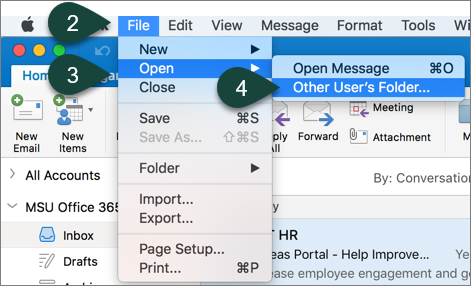
- Open Outlook for Mac.
- Select File.
- Select Open.
- Select Other User's Folder.
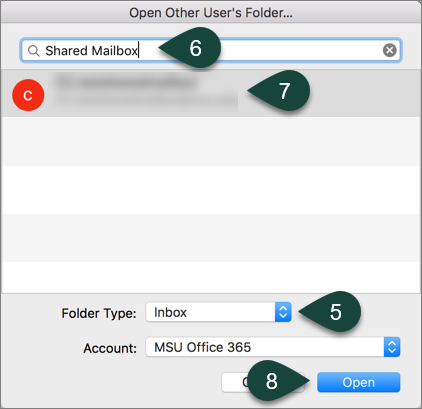
5. Select Inbox from the folder type drop-down menu.
6. Enter the Title of your shared folder in the search box.
7. Select your Shared Mailbox from the list.
8. Select Open.
To access a shared mailbox on a mobile device
- Sign in to your primary account in Outlook for iOS or Android.
- Tap the Add Account button in the left navigation pane, then tap Add a Shared Mailbox.

- If you have multiple accounts in Outlook Mobile, select the account that has permissions to access the shared mailbox.

- After the account setup process completes, the shared mailbox will display in your account list in Outlook for iOS or Outlook for Android.
- To remove a shared mailbox, go to Settings > Accounts. Then tap on the shared mailbox and select Delete Account.
Open and use a shared mailbox in Outlook on the web
Add the shared mailbox so it displays under your primary mailbox
If you want to monitor the email from your primary mailbox and the shared mailbox at the same time, use this method. After you complete this task, the shared mailbox and its folders are displayed in the left navigation pane each time you open Outlook on the web.
- Sign in to your account in Outlook on the web.
- For Exchange Online mailboxes, right-click your email address in the left navigation pane, and then choose Add shared folder
- In the Add shared folder dialog box, type the name or email address of someone who has shared a mailbox with you, and then click Add. Or, type the name of the shared mailbox you are a member of, such as info@contoso.com.
The shared mailbox displays in your Folder list in Outlook on the web. You can expand or collapse the shared mailbox folders as you can with your primary mailbox. You also can remove the shared mailbox from your Folder list. To remove it, right-click the shared mailbox, and then click Remove shared folder.
Use the shared calendar in Outlook on the web
One of the great things about using a shared mailbox is that anyone who has access to the shared mailbox also has full access to the calendar. You can create, edit, and delete events in the calendar. Use the shared calendar just as you would use your own calendar. Here's a short list of things you can do with the shared mailbox calendar:
To access the shared calendar, do the following:
- Sign in to your mailbox using Outlook on the web, and then select Calendar.
- Right-click Other Calendars, and then click Open calendar.

- In From directory, search for the shared calendar you want to open. Select the shared mailbox you want to open, and then click Open.
- The shared calendar displays in your Calendar folder list.
Open a shared folder or mailbox in Outlook for Mac
Please review the following link for assistance with Outlook for Mac - Outlook for Mac